 Rated 5 Stars on Google
 23710 Vanowen St, West Hills, CA 91307
 818-346-9363
West Hills summers don’t give you any grace. When the San Fernando Valley heat hits, and you slide into your Mercedes expecting a blast of cold air, anything less than full-force cooling is immediately noticeable. Whether your AC is blowing warm, barely moving air, or cycling on and off without reaching temperature, something in the system has failed or is failing — and on a Mercedes, that means a diagnosis that requires more than a refrigerant top-off at a quick-lube. Bavarian Workshop on Vanowen Street has been handling German auto repair in West Hills since 1994, and Mercedes AC problems are among the most common summer calls they receive. Here’s what’s actually going on when your Mercedes stops cooling the way it should.
Refrigerant Loss: The Most Common Starting Point
Mercedes AC systems are sealed, so refrigerant doesn’t wear out or deplete under normal conditions. When the system runs low on refrigerant, it means there’s a leak somewhere in the system — a cracked hose, a failed O-ring, a deteriorating condenser, or a seal at the compressor that’s no longer holding. The result is reduced cooling capacity that worsens gradually until the AC either blows warm air entirely or the compressor cycles off to protect itself from running dry. A proper diagnosis involves checking system pressure, identifying the leak point with a UV dye test or electronic leak detector, repairing the source, and recharging the system with the correct refrigerant for your specific Mercedes model — either R-134a or R-1234yf, depending on the year. Simply recharging without finding the leak is a temporary fix that puts you back in the same position within a season.
Compressor Failure: When the Heart of the System Gives Out
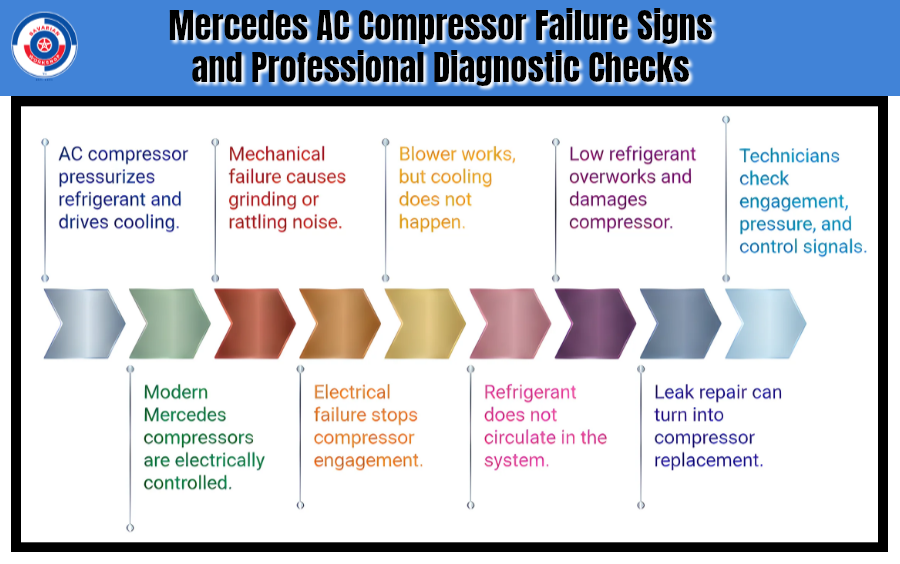
The AC compressor is the component that pressurizes the refrigerant and drives the entire cooling cycle. Mercedes compressors are electrically controlled on most modern models, which means they can fail mechanically, electrically, or both. Mechanical failure typically produces a grinding or rattling noise when the AC is switched on. Electrical failure can cause the compressor to simply not engage — the system appears to run, the blower works, but there’s no cooling because refrigerant isn’t circulating. Mercedes compressors are also sensitive to low refrigerant levels; running the AC when refrigerant is low overworks the compressor and can cause internal damage that turns a leak repair into a compressor replacement. Bavarian Workshop’s technicians check compressor engagement, pressure, and electrical control signals before recommending any parts replacement.
Blend Door Actuators and Climate Control Electronics
Modern Mercedes vehicles — especially those with dual-zone or tri-zone climate control — use electronically controlled blend door actuators to direct airflow temperature and distribution. When an actuator fails, you may get cold air on one side of the cabin but not the other, airflow that won’t switch between vents, or temperature settings that seem to have no effect. These failures are often misdiagnosed as refrigerant problems because the AC compressor is working fine — the issue is in how the conditioned air is being distributed. Diagnosis requires reading the climate control module for fault codes and testing actuator response, which is only possible with Mercedes-compatible diagnostic equipment. Bavarian Workshop uses factory-grade tools that communicate with all Mercedes modules, giving technicians the full picture rather than relying on guesswork.
Cabin Air Filter and Blower Motor: The Airflow Side
If your Mercedes AC cools but the airflow feels weak, the cabin air filter and blower motor are the first things to examine. Mercedes cabin filters are typically replaced every 15,000 to 20,000 miles, and in West Hills — where dry Santa Ana winds push dust and debris through the San Fernando Valley regularly — they can clog faster than that. A severely restricted filter reduces airflow to the point where the evaporator can actually freeze, which makes the problem worse as ice buildup blocks airflow entirely. Blower motor failure is less common but does occur, typically presenting as a blower that only works on high speed or stops working altogether. Both are straightforward repairs when caught early and addressed by a shop familiar with Mercedes interior systems.
What to Expect at Bavarian Workshop
When you bring your Mercedes in for AC service, the process starts with a full system evaluation — pressure testing, compressor engagement check, refrigerant quality assessment, and a scan of the climate control module for stored fault codes. Nothing is replaced until the root cause is confirmed. All repairs at Bavarian Workshop come with their 2-year/24,000-mile warranty, and early-bird and after-hours drop-off options make it easy to fit service into a West Hills summer schedule. The shop also serves drivers from Calabasas, Agoura, and Woodland Hills.
📍 23710 Vanowen St, West Hills, CA 91307 📞 818-346-9363 🌐 bavarianworkshop.com
FAQ
Why is my Mercedes AC blowing warm air?
The most common causes are refrigerant loss from a leak, a failed compressor, or a faulty blend door actuator. A proper diagnosis is needed to identify the root cause before any repair.
How do I know if my Mercedes AC compressor is failing?
Signs include a grinding or rattling noise when the AC turns on, the AC running but producing no cooling, or the compressor clutch not engaging. A pressure test and electrical check will confirm the diagnosis.
Can a clogged cabin air filter cause AC problems in a Mercedes?
Yes. A severely clogged filter restricts airflow enough to cause the evaporator to ice over, which further blocks airflow and can make the system appear to have a refrigerant problem when the real issue is filtration.
How often should a Mercedes AC be serviced in West Hills?
An annual inspection is recommended given West Hills’s heat and dusty conditions. Cabin filters should be replaced every 15,000 to 20,000 miles, and the refrigerant system should be pressure-tested if cooling performance drops.