 Rated 5 Stars on Google
 23710 Vanowen St, West Hills, CA 91307
 818-346-9363

Your Audi baked all afternoon on Vanowen Street. You climb in, crank the climate control to LO, and get a face full of lukewarm air. In a West Hills summer, when the west San Fernando Valley pushes past 100, that’s a lot more than annoying — it’s the sign of a real fault, and it rarely fixes itself.
A warm-blowing Audi almost always has one of a few problems: low refrigerant from a slow leak, a failing compressor, or a climate-control actuator sending air the wrong way. The trick is knowing which one before you throw parts at it, and that’s where a proper diagnosis pays for itself before the Valley really bakes.
Quick Summary: Key Takeaways
- Most warm-air complaints trace to three causes: a refrigerant leak, a failed compressor, or an actuator/electrical fault.
- A slow refrigerant leak is the usual suspect: Output fades a little each month until a hot day makes it obvious.
- Don’t just ‘recharge and go’: Adding refrigerant without finding the leak wastes money and buys weeks, not seasons.
- Heat exposes weak A/C parts: A compressor or condenser that limped through spring quits when it’s 103 outside.
- Diagnosis first: We find the actual fault so you fix the right part once.
Warm Air Is a Symptom, Not the Problem Itself
“Blows warm” covers several different failures, and they aren’t fixed the same way. Sometimes the compressor never engages. Sometimes it runs fine, but the system is low on refrigerant. Sometimes the air is genuinely cold at the evaporator and a stuck blend-door actuator is mixing in hot air before it ever reaches the vents.
That’s why guessing gets expensive. Throw a compressor at a car that only needed an O-ring, or recharge a system with a leaking condenser, and you’re right back in a week with money gone. A correct diagnosis tells us what actually failed on your Audi before anyone orders a single part.

A Slow Refrigerant Leak Is the Most Common Culprit
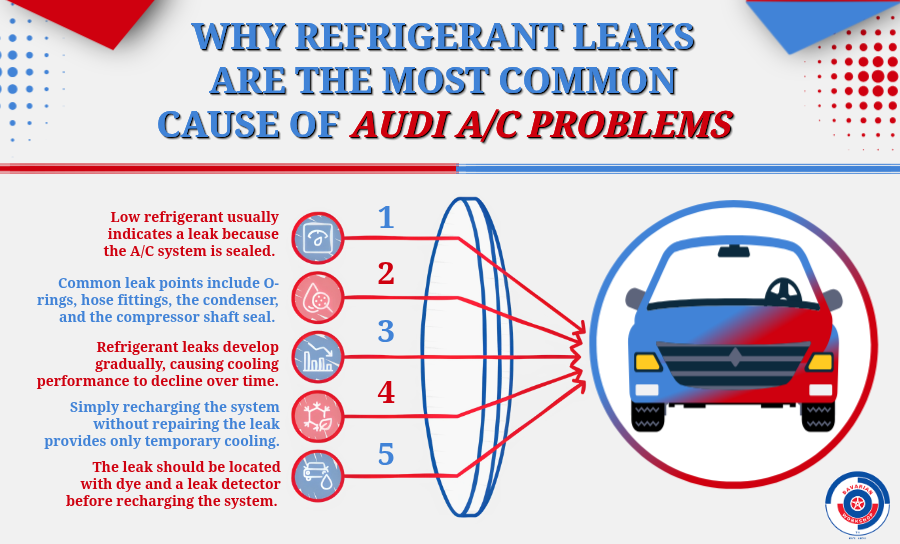
Low refrigerant is where most warm-air Audis land. The system is sealed, so if it’s low, it’s leaking — usually at an O-ring, a hose fitting, the condenser up front where road debris hits it, or the compressor shaft seal — and because the loss is gradual, cooling drops a little at a time until a 100-degree West Hills afternoon makes it undeniable.
This is why a straight recharge is a trap. Adding refrigerant without finding the leak cools the car for a few weeks, then you’re warm again with money spent. So we don’t do that. We use dye and a leak detector to find where it’s escaping, fix that, then recharge to the correct spec.
A Failing Compressor Shows Up When the Heat Peaks
The compressor is the heart of the system. West Hills heat is when a tired one quits. If it won’t engage, or it’s making noise, or it’s leaking, the system can’t build pressure, and the air stays warm — and on higher-mileage Audis, a worn compressor can shed debris into the lines, which turns a single repair into a full system cleanout.
Load is the giveaway. A compressor that seemed okay in mild spring weather often fails once it’s running flat-out against a 103-degree day, so we check compressor engagement, clutch operation, and system pressures to see whether yours is really the problem or just the part that gets blamed.
Actuators and Electronics Can Fool You Into Buying the Wrong Part
Not every warm-air Audi is low on refrigerant. The climate system runs on blend-door actuators, sensors, and a control module, and any of them can fail in a way that mimics a dead A/C — a stuck actuator sends heated air into the cabin even while the evaporator sits stone cold, and no amount of refrigerant will ever fix that.
You need the scan data to tell the difference. We read the climate module for actuator faults and sensor errors, then confirm the temperature right at the vents. It’s the only way to avoid replacing an expensive compressor when the real fault is a $200 actuator. Big difference.
How We Diagnose Audi A/C at Bavarian Workshop
We start with the whole picture, not a refrigerant top-off. Our techs check system pressures, compressor operation, refrigerant charge, the condenser and cooling fans, and the climate-control electronics with factory-grade tools, and that full look tells us the true cause before we quote you a single part.
Then we fix what failed and confirm the vent temperature drops where it should. Every qualifying repair carries our 2-year/24,000-mile warranty. West Hills, Canoga Park, Woodland Hills, and Calabasas drivers count on us to get German A/C right the first time.
Why West Hills Audi Owners Bring Us the Tough A/C Jobs
We’ve specialized in German cars in the San Fernando Valley for decades, and Valley summers keep A/C work rolling in the door all season, so we’ve learned to diagnose before we replace, use correct parts, and tell you straight what’s worth fixing on an older Audi and what honestly isn’t.
No guessing. No parts-cannon repairs. If your Audi is blowing warm, bring it in before the next heat spike and ride out the rest of summer cold.
Frequently Asked Questions
Q: Why is my Audi’s A/C blowing warm air?
A: It’s usually one of three things: low refrigerant from a slow leak, a failing compressor, or a climate-control actuator sending hot air into the cabin. Because those are fixed very differently, the system needs a proper diagnosis — pressures, compressor operation, and the climate electronics — before any part gets replaced.
Q: Can I just recharge my Audi’s A/C myself?
A: You can add refrigerant, but if the system is low it’s leaking, so a recharge without finding the leak only cools the car for a few weeks, and it risks overcharging, which hurts cooling and can damage the compressor — finding and fixing the leak, then recharging to spec, is what actually lasts.
Q: How much does an Audi A/C repair cost?
A: It depends entirely on the cause. A leaking O-ring or a stuck actuator is a modest repair, while a failed compressor that contaminated the system is much more involved, and that’s exactly why we diagnose first — so you pay for the repair your car actually needs instead of guessing at parts.
Q: Why does my Audi’s A/C work in the morning but blow warm in the afternoon?
A: That pattern usually means the system is marginal — low on refrigerant or running a weak compressor — and can just keep up when it’s cool but falls behind once temperatures peak, so when the West Hills afternoon hits triple digits the fault finally becomes obvious, which is a good moment to have it checked.
Get Your Audi’s A/C Fixed Before the Valley Bakes
Tired of lukewarm air on Vanowen? Bring your Audi in for a real A/C diagnosis before the next heat wave.
Bavarian Workshop — 23710 Vanowen St, West Hills, CA 91307
Hours: Mon–Fri 8:00 AM – 5:00 PM; Sat–Sun closed
Website: bavarianworkshop.com