 Rated 5 Stars on Google
 23710 Vanowen St, West Hills, CA 91307
 818-346-9363
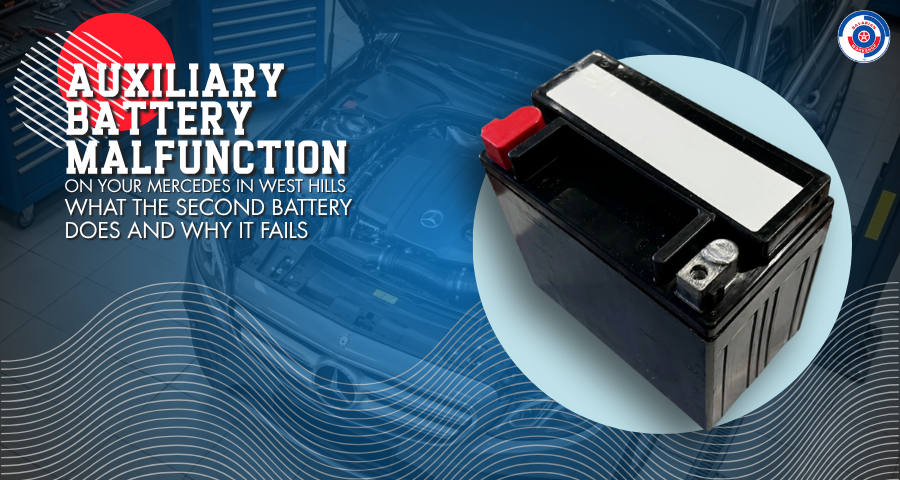
That message is about the small battery, not the big one. Many Mercedes models with ECO start/stop carry a Mercedes auxiliary battery alongside the main one, and the car checks it on its own. When it fails that check, the dash says so. On a cool late-fall morning in West Hills it’s easy to blame the weather and drive on, since nothing else feels wrong and the message just sits there on the cluster. Don’t. Ignoring it leaves start/stop misbehaving while the real cause sits unread in the fault memory.
Quick Summary: Key Takeaways
- Two batteries: the auxiliary battery is a separate, smaller unit from the starting battery.
- Start/stop is the giveaway: an engine that won’t switch off at lights, or won’t restart on its own, often comes with this message.
- The car measures it: a stored fault for high internal resistance is what points to the auxiliary battery itself.
- A quick tester isn’t the last word: for one stored fault on early ML, GL and G-Class models, Mercedes said a handheld battery test couldn’t show the cause.
The Mercedes Auxiliary Battery Backs Up ECO Start/Stop
On the cars Mercedes has written up, the second battery backs up ECO start/stop, which shuts the engine off at a red light and restarts it when you lift off the brake. In an October 2014 service bulletin for the ML and GL (W166 and X166) with ECO start/stop, Mercedes traced the “Additional Battery – Service Required” message to a fault in the start/stop backup battery. The remedy was a new backup battery, but only when a specific fault code was stored.
It’s a small part. Every stop at a light on Fallbrook Avenue that shuts the engine down and fires it back up leans on that system. Exactly what the battery supports varies by model and year, so the scan comes before any parts.
How the Warning Shows Up on the Dash
The wording changes by generation. It always names the extra battery. Mercedes bulletins quote “Additional Battery – Service Required” and a white “Malfunction in additional battery” message, while many owners see “Auxiliary battery malfunction” on their cluster.
The symptoms are mostly about start/stop. The 2014 bulletin files this fault under two of them: no automatic restart, and an engine that won’t turn off at all. You may also notice start/stop simply going quiet for days. That deserves a scan too.
Internal Resistance Is How the Car Judges the Second Battery
Older batteries build resistance. The car judges the small battery by its internal resistance. One can look fine on a quick check and still fail the car’s own test once that number climbs past a limit.
Mercedes wanted to know about temperature and driving habits. When Mercedes was still looking into the “Malfunction in additional battery” message in a May 2016 bulletin for CLA, GLA, B-Class and GL/GLS models, it asked dealers what the temperature was when the fault showed up and whether the owner drove short trips or long ones. That bulletin didn’t name a cause. Still, a week of five-minute hops between Canoga Park and Woodland Hills after cool nights is exactly the driving profile Mercedes asked about, so mention it when you book.
The Stored Fault Code Matters More Than a Quick Battery Test
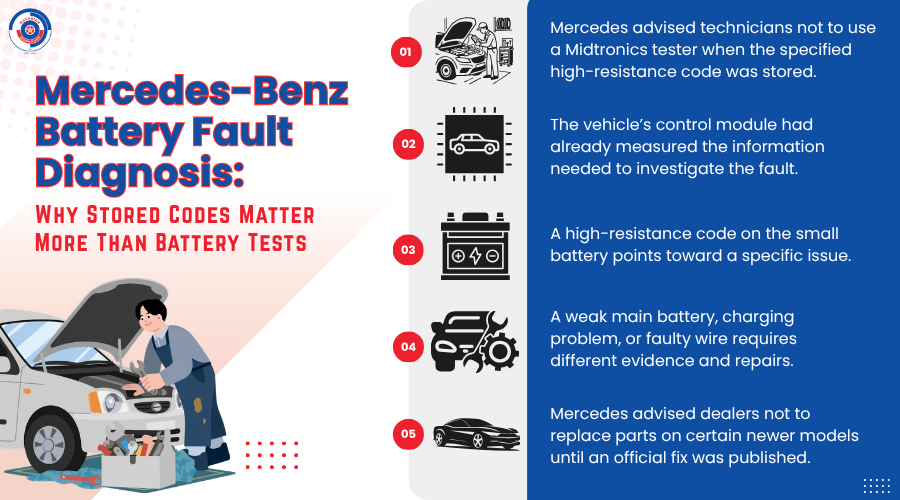
For one stored fault, a handheld battery tester was the wrong tool. In the 2014 bulletin covering early ML, GL and G-Class models, Mercedes told technicians not to run a Midtronics test (the handheld tester dealers use) when the high-resistance code was stored, because the result couldn’t reveal the cause, and it called that an absolute special case. The car’s own control module had already measured what mattered.
Read the code first. A high-resistance code on the small battery points one way, while a weak main battery, a charging problem or a bad wire each leaves different evidence and calls for a different repair with a different bill. On the newer models in the 2016 bulletin, Mercedes even told dealers not to replace parts until it published a fix, which tells you the message alone doesn’t prove the battery is dead.
How Bavarian Workshop Handles It in West Hills
It starts with a scan. Bavarian Workshop reads Mercedes electrical faults with factory-grade equipment. Its Mercedes page says software faults get fixed with the factory scan tool. When an electrical part does need replacing, the shop fits new OEM parts.
Owners from Woodland Hills, Calabasas and Agoura make the short drive in along Ventura Boulevard or the 101, and repairs carry the shop’s 2-year/24,000-mile warranty.
Frequently Asked Questions
Q: What does auxiliary battery malfunction mean on a Mercedes?
A: It means the car has flagged a problem with its second, smaller battery, which on many models supports ECO start/stop. A stored fault code shows whether the battery itself has failed or something around it is causing the message.
Q: Will a new main battery fix the auxiliary battery warning?
A: Usually not. The message refers to the separate auxiliary battery, so replacing the starting battery leaves the actual fault in place. Have the codes read first so the right battery, or the right wire, gets the attention.
Q: Why does my Mercedes auxiliary battery warning come and go?
A: The fault doesn’t always show. In 2016, Mercedes asked dealers how often the message appeared and whether it followed a long idle or a brief refueling stop, which tells you an intermittent message can still be a real fault.
Get the Code Read Before Start/Stop Quits Entirely
Book it this week. Early-bird and after-hours drop-off at 23710 Vanowen St, West Hills, CA 91307 means the Mercedes can go in before the workday starts, and the shop runs a free shuttle. The appointment form lives on bavarianworkshop.com, and mentioning whether start/stop has stopped working saves the technician a step.