 Rated 5 Stars on Google
 23710 Vanowen St, West Hills, CA 91307
 818-346-9363
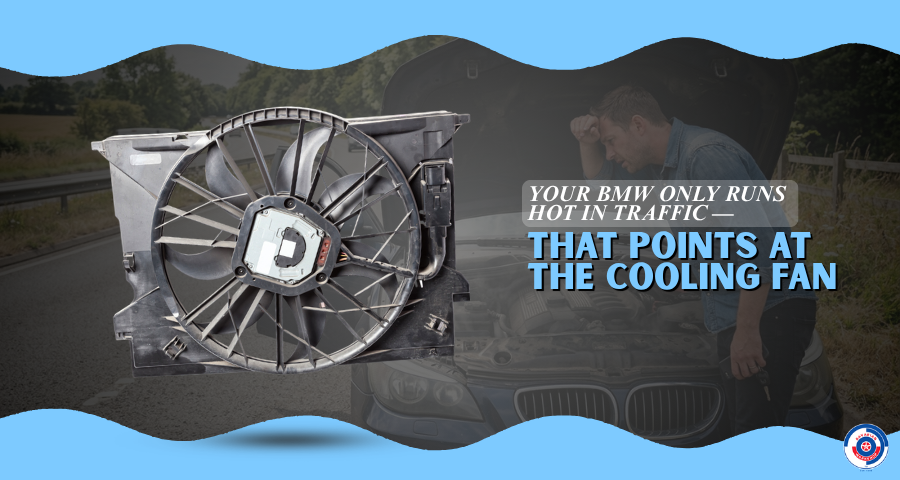
On the freeway the needle sits where it always sits. Then you come off the 101 at Valley Circle, sit through two light cycles, and the gauge starts to climb. Move again and it settles.
Temperature that depends on your speed is a fan problem, not a radiator problem. Above about 35 mph, air pushes through the radiator on its own; below that, the only thing moving air is the fan — and on modern BMWs the fan is electric, controlled by a module that fails more often than the motor it drives. Bavarian Workshop has been the German shop on Vanowen Street for years, and this one arrives every autumn once traffic gets heavy again. Left alone, it ends in a head gasket.
Quick Summary: Key Takeaways
- Speed decides the symptom: hot in stop-and-go, normal on the freeway, back to normal once you move.
- The control module fails before the fan motor: it switches high current and it cooks itself doing it.
- Listen after shutdown: a healthy fan often runs on for a minute or two after a hot drive.
- Nothing may show on the dash: many failures store a code without lighting a warning.
- Valley heat runs into November: average highs stay in the mid-70s through the month.
A Cooling Fan Earns Its Keep at Zero Miles Per Hour
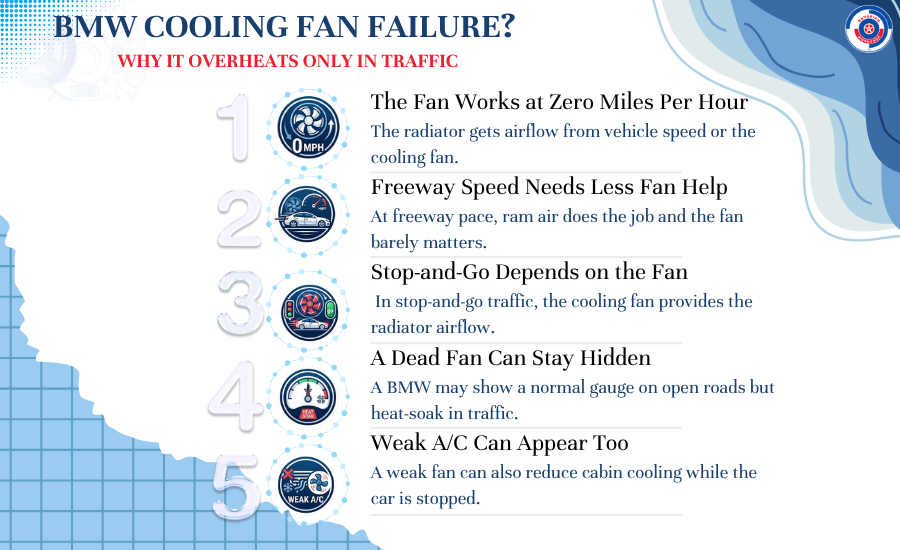
Airflow through the radiator comes from two places: your speed, and the fan. Once you’re moving at freeway pace, ram air does the job and the fan barely matters. In stop-and-go on Roscoe or Sherman Way, it does all of it.
That’s why a dead fan is invisible for months. A BMW with no fan at all will show a perfectly normal gauge on an open road and then heat-soak in a queue, and because it also pulls air across the A/C condenser sitting in front of the radiator, weak cabin cooling at a standstill often turns up in the same conversation.
The Electric Fan Module Is the Usual Culprit
Older sixes used a belt-driven fan with a viscous clutch, and those quietly stop gripping. Everything since runs an electric pusher fan whose speed is controlled by a module — the output stage that switches a lot of current through a small package sitting right behind the grille in the hottest air on the car.
It fails there. Melted connectors, cracked solder joints, a fan stuck at full speed or stuck off entirely. A fan that roars from cold start is the same fault as a fan that never runs, because a module in default mode either commands everything or nothing. The plastic impeller can also shatter and take the radiator core with it.
How We Confirm It Instead of Guessing
It’s a short list of checks. Command the fan on with a scan tool and watch whether it spins and at what duty cycle. Check the fuse and the relay. Look at the connector for heat damage, then measure the voltage actually reaching the motor.
If the fan spins on command but never comes on by itself, the coolant temperature sensor or the control logic is the suspect rather than the fan. Guessing costs money here, because a fan assembly is not a cheap part and swapping one to find out is an expensive way to run a test.
The Valley Stays Warm Long After Summer Ends
West Hills does not get an October cool-down. By NOAA’s 1991 to 2020 climate normals, Van Nuys Airport averages an 83-degree high in October and 75 in November, and the first freezing night there normally doesn’t arrive until December 30.
So the fan matters for months yet. Add school traffic and the afternoon crawl on the 101, and October is genuinely harder on a cooling system than a quiet week in August was. If the gauge has moved once, treat it as information rather than a fluke.
An Overheat Costs More on a BMW Than on Most Cars
These engines use aluminum heads, plastic cooling components and tight tolerances, and they do not tolerate one bad afternoon. A single hard overheat can warp a head, crack a thermostat housing or push a head gasket, and the repair bill jumps by an order of magnitude.
So the rule we give customers is simple: if the needle climbs above its normal spot, pull over and let it cool rather than nursing it home. Repairs here carry a 2-year, 24,000-mile warranty, we’re an authorized Dinan dealer, and every car gets a free hand wash before it goes back to you.
Frequently Asked Questions
Q: Why does my BMW overheat in traffic but not on the freeway?
A: Because freeway speed forces air through the radiator without help. In traffic the electric fan is the only source of airflow, so a failed fan or fan module shows up as temperature that climbs when you stop and falls when you move.
Q: How do I know if my BMW cooling fan is bad?
A: Listen after a hot drive — many run on briefly after shutdown. A fan that never spins at idle with the A/C on, or one that howls at full speed from a cold start, both point at the fan or its control module.
Q: Can I drive my BMW with a bad cooling fan?
A: On open roads it may seem fine, and that’s the trap. One long queue on a warm afternoon is enough to overheat it, and on these engines an overheat can mean a head gasket instead of a fan.
Q: Does the cooling fan affect the air conditioning?
A: Yes. The A/C condenser sits ahead of the radiator and depends on the same airflow, so a dead fan often shows up as cooling that works at speed and fades at a stoplight.
Get the Fan Tested Before the Next Traffic Jam
Tell us where the needle sits and what you were doing when it moved. Freeway or stopped? That answer alone shortens the diagnosis.
Bavarian Workshop, 23710 Vanowen St, West Hills, CA 91307. Open Monday through Friday, 8:00 AM to 5:00 PM. Online at bavarianworkshop.com.