 Rated 5 Stars on Google
 23710 Vanowen St, West Hills, CA 91307
 818-346-9363
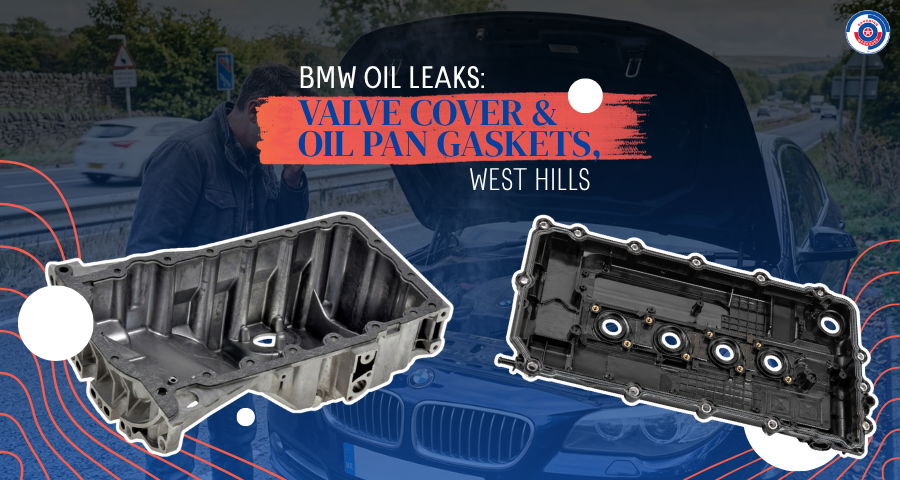
Dark spot on the concrete. Then a whiff of burning oil as you pull into the driveway on Vanowen. Those two clues cover most BMW oil leaks in West Hills, and nine times out of ten the source is one of three gaskets: valve cover, filter housing, oil pan.
Small leaks stay small for a while, then they don’t. A single gallon of used motor oil can contaminate a million gallons of fresh water, according to the EPA, which is one reason a dripping N52 in a Woodland Hills driveway matters beyond your wallet. The other reason is the accessory belt sitting directly under that filter housing.
Quick Summary: Key Takeaways
- Burning smell, no puddle: Valve cover gasket leaks drip onto the hot exhaust manifold and smoke long before they reach the floor.
- The belt eater: An oil filter housing gasket leak soaks the accessory belt on N54, N55, and N63 engines and can drag debris behind the crank seal.
- Labor, not parts: A $40 oil pan gasket becomes a $1,300 to $1,800 job because the front subframe has to come down on many BMWs.
- Root cause first: A clogged crankcase vent pressurizes the case and pushes oil past brand-new gaskets within months.
- Watch the level: A quart gone every 1,000 miles is a real leak, not normal consumption for a modern BMW.
Three gaskets cause almost every BMW oil leak we see
Begin with location. Valve cover gaskets leak down the side of the head onto the exhaust, while filter housing gaskets soak the accessory belt and the front of the block. Oil pan gaskets drip straight down, dead center under the car. Three locations, three diagnoses.
The N52 valve cover is plastic bolted to a magnesium head, and it warps through enough heat cycles that the seal stops following the surface it’s supposed to squeeze. So a 90,000-mile E90 shows up smoking with a dry garage floor. Identical story on plenty of F30s.
The smell tells you more than the puddle does
Follow your nose first. Oil on hot metal smokes around 400 degrees, so you’ll smell a valve cover leak long before you see it. Look for haze off the passenger side after a run up the 101, brown crust along the valve cover rail, and a light film on the exhaust heat shield.
Pan leaks behave differently. It collects, drips, and marks the same spot on your driveway every night. Check the level. A quart low between 5,000-mile changes on an N20 or B58 deserves a real inspection instead of a top-off and a shrug. Topping off isn’t a repair.
Crankcase pressure is the reason new gaskets leak again
The hidden cause behind repeat leaks is a clogged crankcase ventilation valve. The CCV pulls blow-by vapor back into the intake, and when its diaphragm splits or its lines clog with sludge, crankcase pressure escapes past the softest seal in the engine. That’s usually the gasket you just paid for.
Diagnose first. Rough idle, a whistle at the dipstick tube, and oil in the intake boot all point at the CCV rather than the gasket itself. Cheap part. Big consequence.
Ignoring a filter housing leak costs a belt and sometimes an engine
The oil filter housing gasket is the dangerous one. On the N54, N55, and N63 that gasket sits right above the accessory belt, and oil-soaked rubber shreds, wraps the crank pulley, and can drag debris behind the front crank seal. That repair begins near $3,000.
Done on time, the gasket and belt run $500 to $900. Same leak, two invoices. Anyone driving a 2011 to 2016 turbo BMW past 80,000 miles should have that gasket inspected at the next oil change. Request the inspection.
What an oil leak repair looks like at our West Hills shop
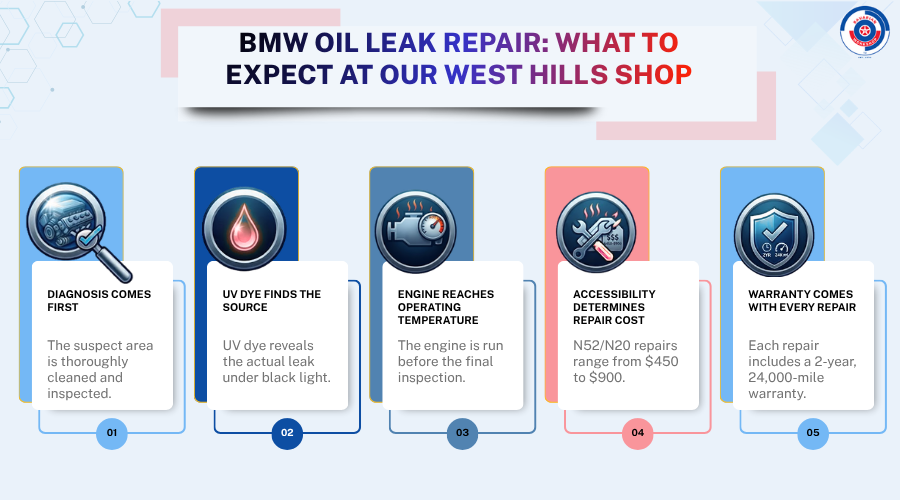
Diagnosis comes first, and it isn’t a flashlight and a guess. Our techs degrease the suspect area, add UV dye to the oil, run the engine to temperature, then re-inspect under black light so the real source shows instead of the place gravity carried the oil. Then you get a number.
Valve cover gaskets on an N52 or N20 usually run $450 to $900, and an oil pan gasket on an xDrive car runs higher because the front subframe has to come down. Accessibility determines the labor. Marc’s crew has been sealing these engines on Vanowen Street since the shop’s early Dinan days, and every repair carries a 2-year, 24,000-mile warranty plus a hand wash before pickup.
Frequently Asked Questions
Q: How do I know if my BMW valve cover gasket is leaking?
A: Smell before sight. Oil seeping onto the exhaust manifold smokes and gives off a sharp burnt odor after a drive, often with no drip on the floor. Open the hood and look for brown crust along the valve cover edge and a film on the heat shield. UV dye confirms it in one visit.
Q: Is it safe to drive a BMW with an oil leak?
A: It depends which gasket. A weeping valve cover you check weekly is different from a filter housing gasket dumping oil on the accessory belt, which can strand you on the 101. Any leak costing a quart every 1,000 miles or dripping onto the exhaust should be repaired now.
Q: Why is my BMW leaking oil again after a new gasket?
A: Usually crankcase pressure. A failed CCV valve pushes oil past fresh seals within a few thousand miles, so the vent system has to be tested during the original repair. A warped plastic valve cover or an over-torqued bolt will do it too.
Get the leak found before it finds your belt
Bring the car to Vanowen Street and we’ll dye-test the leak, show you the source, and quote the gasket that’s actually failing. Early drop-off works, and a free hand wash comes with any service.
Hours: Mon–Fri 8:00 AM – 5:00 PM; closed Saturday and Sunday
Website: bavarianworkshop.com