 Rated 5 Stars on Google
 23710 Vanowen St, West Hills, CA 91307
 818-346-9363

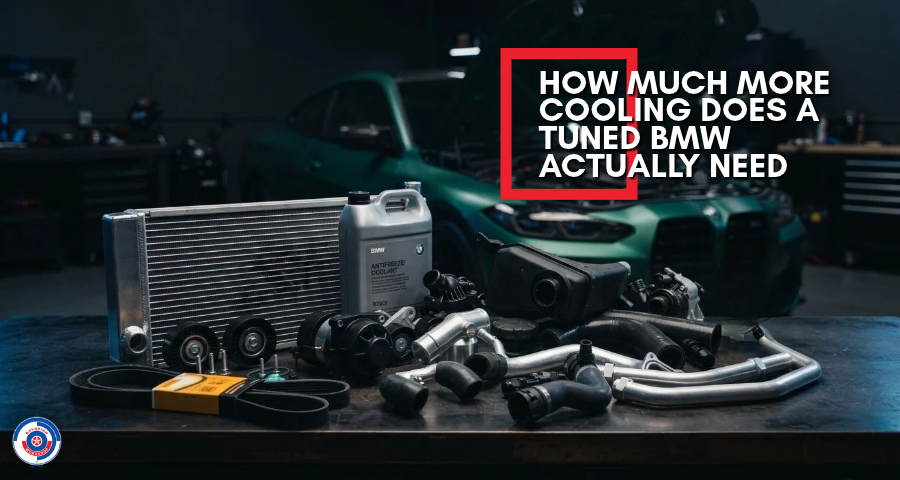
It is the question that comes up as soon as anyone talks about adding power: does a Dinan-equipped or built BMW need a bigger radiator? The short answer is that it usually needs a healthier cooling system before it needs a larger one. West Hills sits at the west end of the Valley where afternoon temperatures stay high well past the calendar’s opinion on the matter, and the cars that get into trouble here are rarely the ones with too little radiator. They are the ones running a ten-year-old system at a power level it was never asked to handle.
More power means more heat, and most of it leaves through the coolant
An internal combustion engine turns a minority of its fuel energy into motion. The rest leaves as heat, split roughly between the exhaust and the cooling system, so a tune that adds a third more power raises the heat load on a similar scale.
The exhaust side takes care of itself. The coolant side does not. The water pump, the radiator, the thermostat and the expansion tank are all still the parts BMW specified for the stock output, and every one of them is now working closer to its ceiling. Nothing fails immediately. What happens is that the margin disappears, so the car that used to shrug off a climb up Topanga Canyon now creeps toward the top of its temperature range.
That margin is the real subject here. A healthy stock system has plenty of it, a tired one has none, and a tune is what exposes the difference. Vehicle fires are not a rare event either: the National Fire Protection Association puts US fire departments at an annual average of 215,096 vehicle fires between 2018 and 2022, about 16 percent of every reported fire incident. The causes vary enormously, and an engine bay with no thermal headroom left is one condition nobody wants to add to the list.
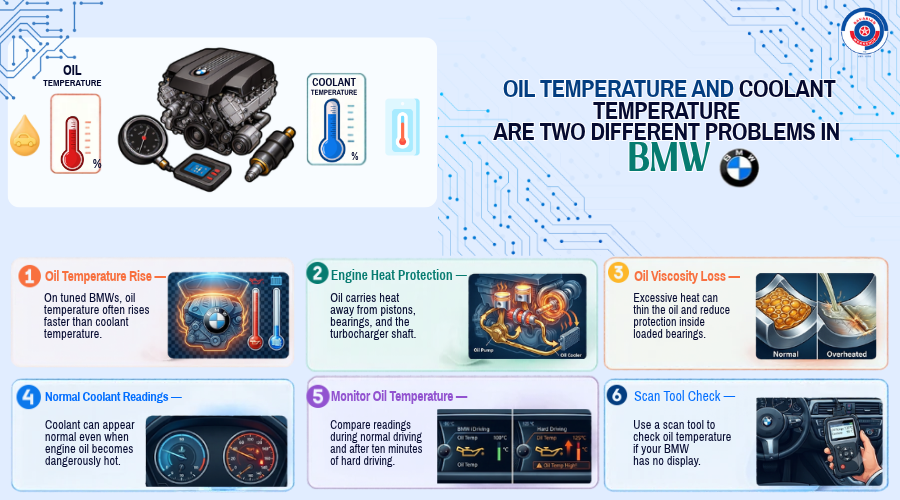
Oil temperature and coolant temperature are two different problems
Owners watch coolant temperature because that is the number the dash shows. On a tuned BMW, oil temperature is usually the one that moves first and the one that matters more.
Oil carries heat out of the places coolant cannot reach — the piston undersides, the bearings, the turbocharger shaft. Push the output up and oil temperature climbs faster than coolant temperature does, because the oil is doing more of the work. An engine can sit at a perfectly normal coolant reading while its oil is hot enough to lose viscosity, and thin oil in a loaded bearing is how expensive things happen.
If your car has an oil temperature display, learn what it reads on a normal commute and what it reads after ten hard minutes. If it does not, a scan tool will show you the value, and that baseline is worth more than any opinion about whether you need a bigger cooler.
A lower-temperature thermostat is not a cooling upgrade
This one comes up constantly, so here is our position on it. A cooler thermostat opens sooner. It does not add capacity, it does not move more heat, and on a street car it mostly means the engine takes longer to reach the temperature its fuel and oil strategy were calibrated around.
Where it earns its place is on a car that is heat-soaking repeatedly — back-to-back runs, long climbs, sustained load — because starting each cycle cooler buys time before the system saturates. Where it costs you is on short winter errands around Canoga Park, in slightly worse fuel economy and more condensation in the oil.
Our advice is to fix capacity and condition first and treat the thermostat as a tuning choice afterward, not as a repair for a system that is already struggling.
Keep the system sealed, and keep the mix right
Pressure is free cooling capacity and most people throw it away. A sealed system raises the temperature at which the coolant will boil, and the cap on the expansion tank is the only thing holding that pressure in. A worn cap on a tuned engine is therefore not a minor item, and neither is a weeping hose or a crazed expansion tank.
Concentration belongs in the same conversation. A system topped off with tap water enough times has drifted away from the mix it was designed around, and it boils sooner for it. The minerals are their own problem: the U.S. Geological Survey classifies water above 180 milligrams per liter of calcium carbonate as very hard, and those minerals plate out as scale on the hottest surfaces in the engine — which on a high-output build is precisely where you need heat to move.
Before anyone orders an aluminum radiator, we would rather pressure-test what is there, check the concentration, and replace the cap. That is a cheap afternoon and it solves a surprising share of the complaints.
What we look at before and after a build
On a car coming in for added power, the cooling inspection is part of the job rather than an upsell. We look at the water pump and its impeller, the thermostat housing, every plastic fitting in the circuit, the condition and concentration of the coolant, and the radiator core for bent fins and debris packed against the condenser.
Afterward, the car gets run up to temperature under load and the numbers get recorded — coolant, oil, and the margin between where the system settles and where it runs out of room. That record is what tells us whether a larger radiator or an added oil cooler is justified for the way you actually drive the car.
For engines we build in house, cooling capacity is specified at the start, because it is far easier to plan around a cooler than to find room for one later.
The Cooling Inspection Comes First
If a tune or a build is on your list this winter, bring the car in for a cooling inspection first and let the results shape the plan.
Bavarian Workshop — 23710 Vanowen St, West Hills, CA 91307